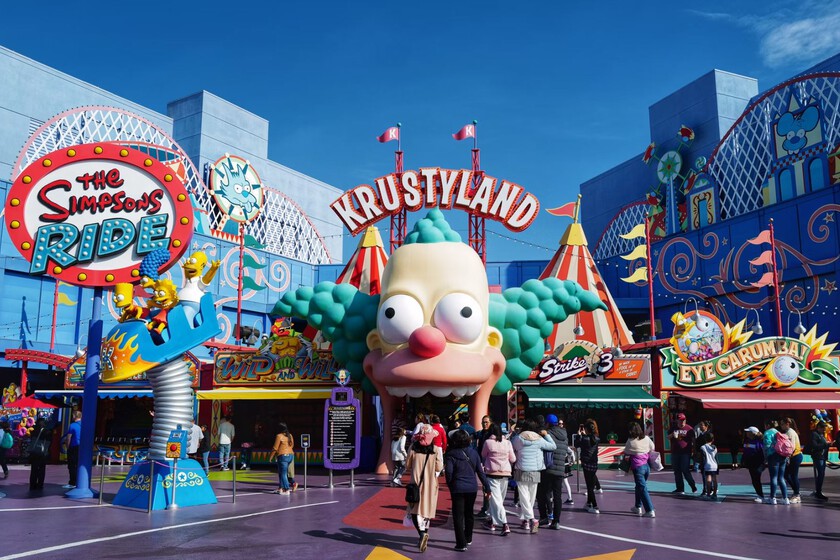
There are people who are repulsed by the amusement parks. Too many people, too much time wasted in lines, fear of attractions… I’m on the complete opposite side. For me the ideal trip includes a visit to an amusement park in the area, and if it turns out to be a great park, it’s like feeling like I’m inside a video game..
Lately I’ve been reviewing the history of the most mythical amusement parks and, reading about the design process and what’s behind the most emblematic ones, you end up discovering that it actually looks a lot like the design of a video game. In fact, designing an amusement park is the closest thing you’re going to find in the real world to creating a video game.
The GOTY of amusement parks
Not just any video game, mind you. Here we are aiming at a triple A. By budget, by ambition and by team size. But beyond the obvious, the truth is that reading about it has been to discover a most interesting approach to the duality between the two worlds.
Also the perfect example that, as in video games, there are parks that are very well done and others that are not so well done. So… just because you don’t like going to the fair doesn’t mean that you won’t be amazed when you walk through the GOTY of amusement parks.
From offering variety to the visitor to generating a narrative with the objects you see around you. From managing queues with a mix of mathematics and entertainment to guiding the visitor without leading him by the hand.
Just by taking a look at the Mickey Mouse Decalogue for the parks Disney you can easily appreciate the similarities between the design of an amusement park and that of a video game.
The Architect of Disneyland
Martin Sklar started working in Disney in 1955 with an important task, but far more humble than anything he was to do later: creating The Disneyland News newspaper that was sold at the entrance to the park. But he soon played a much bigger role in the park’s success. After a stint in marketing, he ended up becoming the creative guy who designed, tested and implemented the parks’ big breakthroughs.
“Working with Walt Disney was the biggest litmus test anyone could experience. The test was Walt, who was always coming up with new ideas and improving on everyone else’s input.
The fire was that we were constantly breaking new ground to shape deadline-driven projects that had never been attempted in this business. This, I’m proud to say, never stopped in my years at Disney.”
His was, without going any further, the attraction “It’s a Small World“The boat ride in which children from all over the world sang a catchy and insufferable song. It is so mythical that we have seen it parodied ad nauseam in animated series like The Simpsons, but the truth is that it is a sort of emblem for the house of dreams, and even Disneyland Paris has its own version.
If the thing about sticking Walt Disney cryogenically under the Pirates of the Caribbean attraction to take advantage of the water in conservation ends up being true someday, it sure was Sklar’s idea. But nevertheless, what he’s most remembered for inside the parks is for shaping what’s known as the Mickey’s 10 Commandments.

Mickey’s 10 commandments
With the expansion of the team and the arrival of increasingly large and ambitious projects, Sklar decided to create a guide of good practices that he would post on doors and windows so that all workers could internalize them. These are the rules he created and how they can be adapted to the world of video game design.
1) Know your audience
- In the park: identifies the target audience for your next attraction.
- In a video game: knowing your target audience is key. You’re not going to put gore and explicit violence in Fortnite when you’re all about keeping as many players as possible. They know they need the youngsters, so their machine guns and rocket launchers don’t even kill you, they just leave you lying on the ground.

2) Put yourself in your visitors’ shoes
- In the park: insists that team members try the new experience just as the attendees will.
- In a video game: it may not have been so in the past, and now it has more than a few exceptions, but everything related to the user experience comes precisely from there, from the UX and UI designer who, in the most empathetic way possible, puts himself in the position of the future player to condition the game.
3) Organize the flow of people and ideas.
- In the park: the representation of stories and experiences must follow a logical and sequential order.
- In a video game: to be able to take the Highwind and fly at your leisure around the map of Final Fantasy VII you must first have followed a particular order, the one the designer wants to use to tell his story. It’s not much different from what still happens today in almost any open world. You can go wherever you want, but the path of the story usually follows that same sequential logic.
4) Create a carrot
- In the park: creates visual objectives that guide the visitor clearly and logically through the facility.
- In a video game: the peak on the horizon of Journey, the mountain of God of War, the flow lines of Elden Ring’s tutorial that wrongly pushed you towards the exit. The guidance by the designer, more or less explicitly, like a fair or like the triple A of amusement parks, is always there to take us by the hand without us noticing it.

5) Communicate visually
- In the park: make good use of color, shape, texture and all opportunities for nonverbal communication.
- In a video game: screens that are stained with blood to show that you have been damaged, objects masterfully placed to tell us what has happened in that part of the stage without explicitly telling us about it, the festival of lights and shapes that any stage of the first Mirror’s Edge boasts.
6) Avoid overloading
- In the park: resist the temptation to overload your audience with too much information and objects.
- In a video game: the difference between guiding and distracting the player. Here the yardstick depends on the patience of each one, but if there are people who are overwhelmed by the multiple paths with comings and goings of a metroidvania (guilty), or others who can not stand to be faced with an avalanche of objects in the inventory that do not know what they are for, it is precisely because of a problem of saturation.
7) Tell only one story at a time
- In the park: if there is an excess of information break it up into different logical and organized stories that people can absorb and retain more clearly.
- In a video game: even within the variety they offer and how different some worlds can be from others, even the environmental narrative always follows the same logic. First the jungle levels, then the sea levels, but rarely do you jump from one to the other and back again. You can have several plots, of course, but few dare to intertwine them excessively with time jumps. They usually follow a certain logic.
8) Avoid contradictions
- In the park: identity is crucial to being competitive. The public must know who you are and differentiate you from other institutions they may have seen.
- In a video game: Probably one of the clearest examples on the list. We have lost count of the games that have gone down the drain for wanting to be the new X by being too similar to the original work. Few manage to turn that tortilla around. In the same way, sagas that abandon the original concept too much risk being looked down upon by the community.
9) At every step, a diversion
- In the park: give people a wealth of opportunities to have a good time and participate in the experience by turning their surroundings into an attractive and eye-catching setting in every way (and that’s why every time you sit down to watch a show you get the smell of popcorn).
- In a video game: the definition of a sandbox, a game that allows you to go wherever you want and that, at every step you take, you have the opportunity to do something interesting, whether it’s enter a store, get your ass kicked or compete in a race.

10) Keep it up
- In the park: never underestimate the importance of cleanliness and maintenance routines, people always expect to see a great show, and will comment further on anything they see broken or dirty.
- In a video game: Cyberpunk 2077, Mass Effect Andromeda, Assassin’s Creed Unity… Being talked about even badly is not usually good advice in the video game world, as it is not usually good advice in any other field where someone can go on the internet to say what they didn’t like. Not only do you demand varied and eye-catching, you should also be as perfect as possible.

The details that make the difference
But it is not only the decalogue of Martin Sklar comes close to marrying video game and amusement park design, even beyond the adrenaline and action that a roller coaster can offer, so does something as mundane and simple as the queues.
There’s a reason why, in a video game, the idea of watching the character slow down to get through an opening in the rock is so much more palatable than waiting for the bar to fill up for a loading screen.
It makes us part of that process and, although it is far from being the most fun of the experience, it can also be something positive in both the digital and real world. You just have to know how to dress it up.
It’s the big difference between standing in line at a more humble – or poorly organized – park versus standing in line at the Rolls-Royce of amusement parks. What the heck, in the Super Mario Galaxy of amusement parks.
In the former you have queues that go back and forth with a soporific and tedious experience in which the only amusement is watching people go by, talking to your companions -don’t let people go on the rides alone if you can afford it, it loses its fun-, or dreaming about the laughs you’ll have when the note in front of you falls off the railing because he’s being a jerk.
In the second you have constant changes of scenery, a setting that makes you want to see more, details that keep you entertained, rooms where you are told about the experience to explain concepts such as safety inside the attraction in a comfortable way… You can take it as a a good tutorialbut also as the path of growth until you reach the final monster.

Plant a tree, write a book, design a video game and an amusement park.
Despite how much I might enjoy a triple-A, I always appreciate a good indie. Often that lack of budget translates into crazier, riskier ideas. And that’s why you can find water bumper cars at a fair but you won’t see them at a big amusement park.
It’s funny because so much of the text has ended up. more focused on the continent than on the content. More on the duality between the setting of a park and the level design of a video game than on the attractions and their equivalence in the form of mechanics or high points of the experience.

Perhaps my obsession with both concepts is the main culprit for my addiction to management games. If you ask me, few things I see more entertaining than designing the perfect queue for your star attraction in Planet Coaster.
Little is said about the extent to which the ride of. Miyamoto is a designer’s dream. From creating games and props to shaping an amusement park of Nintendo -and supervise a movie-. Hopefully a documentary about it someday.
About Martin Sklar you have the book Dream It! Do It! (15.16 euros on Amazon at the time of this writing) and a series on Disney Plus dedicated to his figure and to the Disney parks called The Imagineering Story. If the idea of designing an amusement park has caught your attention, both are highly recommended.
Image | Sung Jin Cho