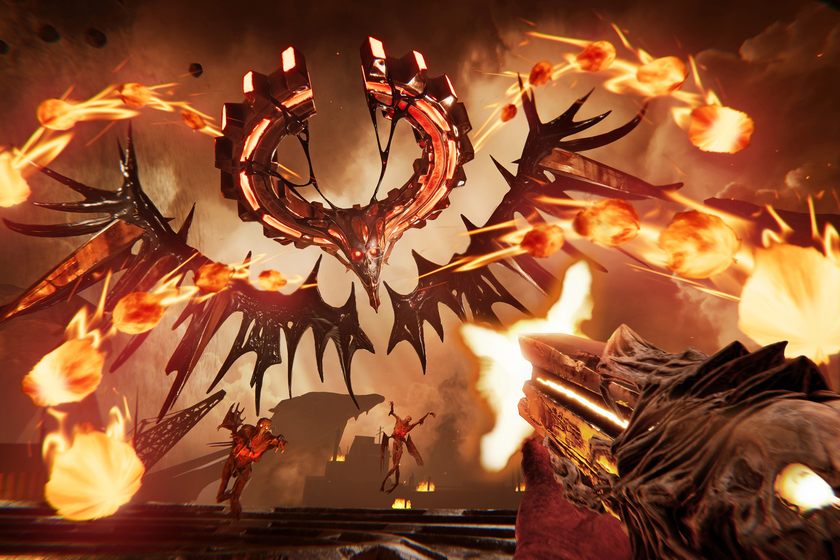
I must admit that I’ve started writing this review a little later than I would have liked – it’s that time of year when so much stuff comes out, it makes you wonder what E3 is for. Be that as it may, the good thing about the fact that all the media have already published their reviews is that I can check opinions before getting down to work. On social networks, the Metal: Hellsinger accounts share an image with quotes and notes from the specialized critics (what we usually call accolades in the middle) full of nines and four stars. On Steam, it boasts an average 97% approval rating in user reviews. From the perspective of a humble servant, maybe I wouldn’t give it such a high score; but since I’m lucky enough to have gotten rid of numerical ratings long ago, I’ll just tell you: it’s pretty cool overall, and I’d say it’s worth it.
If you’re keeping an eye on 3DJuegos PC, you may remember that a few weeks ago I shared some impressions of the title in question. That article was titled “I’ve been replaying the tutorial of this rhythmic DOOM for almost 6 hours, just because of how much fun it is and the great artists behind it”, with special emphasis on the fun factor. I don’t remember any press demo that has hooked me so much, and the blame for that is the fantastic scoring system that is implemented in all levels of the campaign. If you have even the slightest interest in the leaderboards online, mate, I feel for you and even more so for your adult life responsibilities; it’s a sinkhole of hours that go away quite willingly, it must be said. And what about those who just pass it off as a no-brainer? Well, we’ll get to that.
For those less familiar with the subject matter, Metal: Hellsinger is a. boomer shooter rhythmic. In broad strokes, it’s DOOM – a game as violent and explosive as the musical genre it carries as its flagship, forcing you to jump right into the heat of battle by switching weapons quickly and commanding executions whenever you need to heal. It is set in hell, too? It has undeniable thematic parallels. Differences? Well, the importance of sound in the action, of course. And I’m not talking about how well Mick Gordon modulated the sound. All they fear is you to fit it into Slayer’s latest adventures, no. In that sense, it should rather be compared to BPM: Bullets Per Minute or the yet to be released Gun Jam, both with their own tab on Steam. The idea, basically, is to coordinate your shootingsfeints, feints, reloads and ultis with the beats of music.
But I’ll take the liberty of also stating that if The Outsiders has nailed it in anything, it’s in taking all those things and making them 100% their own, functional and independent. It doesn’t matter that other games have done similar things in the past, because after a few minutes of Metal: Hellsinger it becomes crystal clear to you that here one has to think and act in a different way; no more and no less than where the fun of this title lies. The enthusiastic DOOM player programs and memorizes weapon “combos” to maximize the outgoing damage in the shortest possible time, while in David Goldfarb’s latest project it’s not about the lead, but the choreography. Hellsinger’s AI is clumsier than that of id Software’s latest hits, but that’s reasonably tied to the gameplay because you’re supposed to be aware of what’s in front of you in order to think about your next move As you are executing someone.
There are eight hells, each with its own artistic and musical direction.
The difficulty is not in the AI, but in mastering the character’s timing.
Once that dynamic, that unique signature resonates with you, Metal: Hellsinger has won you over. The campaign is completed in one sitting because it lasts less than a concert (I took little more than 5 hours to complete it with all the challenges) and it has the same effect, which is that of the mythical night of debauchery that leaves you tired and euphoric in equal parts. Each of the eight hells you visit have their own art direction both visually and sonically, their arenas are well designed and all have a big boss waiting for you in the last section that puts you to the test. So far so good, and I insist that I really liked the game; but it’s time to start talking about the things that I didn’t like so much, which there are some -which is quite normal, by the way; getting everything right with a new IP is utopia. Let’s say there are small failures.
For example, I find it a bit weird that you spend 10 minutes to familiarize yourself with. the rhythm of each levelonly for you to get to the boss fight and find that the beats The gameplay is fast-paced: it completely throws you off, takes you out of place and makes you slack off just at the point in the game where thematically you should feel like a goddamn hero. One of lime and one of sand, being the little point in favor the fact that although there are only two bosses that are reinvented throughout the campaign (one at the end and another that is repeated in each level) is able to surprise for good. I also don’t like the fact that the challenges, which logically orbit around the idea of testing your skill and temperance, make you go through a loading screen every time you fail. It’s a technical issue, yes, but it’s still a bummer that many other games with that feature have done better.

Each stage ends with the same boss, but this one surprises with fresh mechanics every time.
Some of these challengesin fact, they seem a bit lazy because they are essentially the same map and objective but changing some of them. spawns The reward for completing them are character modifiers (you can carry a maximum of two) that evolve in the same way, in a staggered way. The reward for completing them are character modifiers (you can carry a maximum of two) that evolve in the same way, in a staggered way. Did we need more variety? Well no, but the mere fact that this option exists already makes me think of it as a necessity. Something similar happens with the history: it never ends up being particularly interesting (I think the epilogue will come off as little short of a meme to many) and the motion art depicting it rarely feels even with the game’s overall palette and art direction. Broadly speaking, that’s as far as the problems go. Beyond these occasional frustrations, the truth is that Metal: Hellsinger does things so well that I’d be hard-pressed not to recommend it to anyone who catches its eye.
I couldn’t conclude the review without talking about the. musicof course. The roster of guest artists invited to lend their voices to each phase is the stuff of true legend: you’ve got Tatiana Shmayluk, Matt Heafy, Mikael Stanne or (my personal favorite) Alissa White-Gluz of Arch Enemy, to name a few; and I sense that they’ve been given free rein to do what they do best, judging by the ripping and screaming -without squeals in sight – of, say, Serj Tankian or Randy Blythe himself. A true dream team that the Avengers would have liked, although if we get picky I would say that I would have appreciated a little more imagination and creativity in the compositions. All of them are very good, but quite literally I would say that the only one that feels legitimately different is Dissolution, by Björn Strid (Soilwork). By the way, since this is original music from Metal: Hellsinger, you can search for it and share it on the internet without fear of being penalized by platforms such as Youtube or Twitch.

Fun, energetic, and satisfying.
Closing the text, Metal: Hellsinger I really enjoyed, and I suspect that if you know what you’re coming for, you’ll like it too. There are a few design holes that can get on your nerves on more than one occasion, but at the end of the day it’s an experience that’s over in an afternoon, you can repeat as much as you want and it has a mind-blowing soundtrack. I imagine that if someday it gets a sequel, the people in charge will want to improve the narrative, the possibilities to interact with the sandbox and the approach of the challenges, but until then: we are in luck, metalheads. In the last few days, by the way, those responsible for the game have announced that it will be possible to import and play our own songs via a future update. Hopefully more of this cool stuff will be coming for a while.