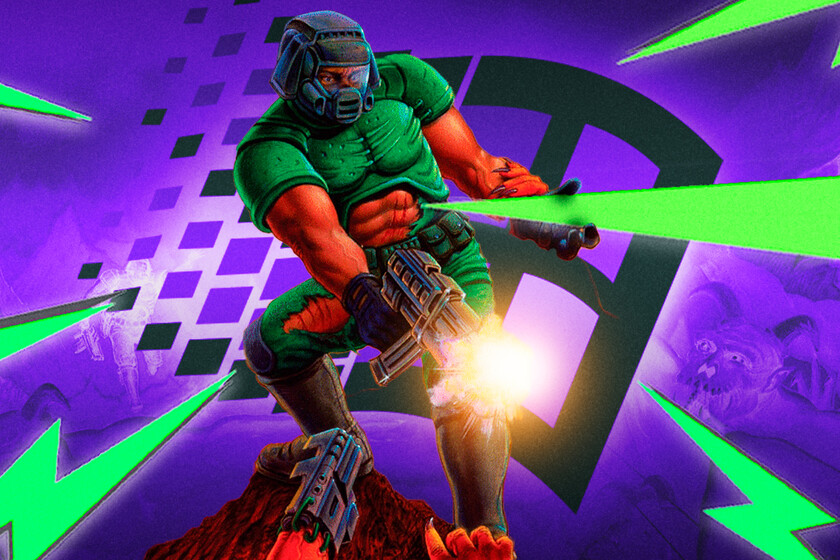
It’s been a long, long time since the release of the first DOOM. The trio of developers John Carmack, Tom Hall y John Romero offered a visceral game, inherited from the first Wolfenstein 3D and with enough appeal to survive almost 3 decadesbut most importantly, it popularized the FPS (First Person Shooter) genre in 1993 and laid the foundations for the PC as the gaming platform. It seems a bit far-fetched to state outright that today’s PC is thanks to a single game, but this is not the first time we have seen that the success of a title marks the future of a console or a entire industry.
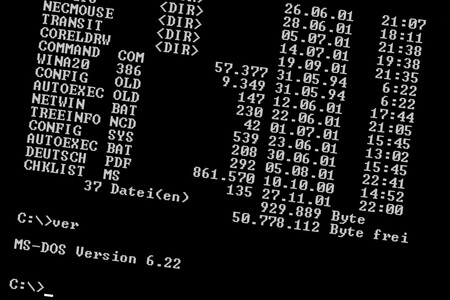
Although today Microsoft’s system takes precedence in gaming computers – if we go by Steam’s data on the hardware and software of the platform’s users – 30 years ago they were running on a lightweight softwarecapable of being housed on a single floppy disk of only 1.44 MB of storage and with a code-based interface. We are talking about MS-DOSthe archaic version of Windows that dominated computers in the 80s and 90s.
The DOS family system released in 1981 was crude and very limited in its usability. It operated with just 109 commands with which to move around the system and use its capabilities. They were classic computers, most of them with just 16 MB of RAM and 500 MB storage, but with enough to run DOOM. id Software’s bet was not a console-seller, but a computer-seller. This first title in the saga broke with everything and was crowned with 20 million players just two years after its release. In fact, by 1995, DOOM was installed in more computers than the operating system itself Windows 95.
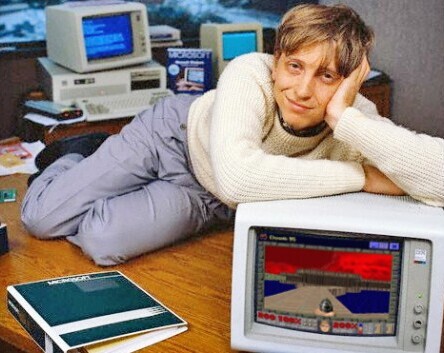
DOOM’s popularity led Bill Gates to consider buying its studio before making a native Windows 95 version.
How could this be possible if Windows 95 was the evolution of MS-DOS? In fact, it’s easy to explain if we imagine a similar situation With Fortnite, for example. Reducing it to the extreme, if the most profitable multiplayer of the last years were available only on PS3 and Xbox 360, even with the current PS5 and X/S Series on the market, most users would crown their set-up with the seventh generation of consoles. We are talking about a boom effect, an experience that marked a before and an after and that led the decade-old MS-DOS operating system to take precedence over Windows 95; something that drove the Gabe Newell.
At 1995Even with DOOM II: Hell on Earth on the market, people were still flocking to the original DOOM, so the then 33-year-old producer and developer of the first three Windows versions made the decision to assemble a small team to develop a new version of the game. port DOOM to Windows 95 under the approval of John Carmack. As Newell himself told GamesRadar in 2007, the idea was to make a version that would arrive under the name DOOM 95, completely free of charge and under the flagship technology of the moment for Microsoft: DirectX.
My jump into the gaming industry came when I was working on Windows in the old days of DOS extenders and pirated config.sys boot disks. I was the producer of the first three Windows releases. It was common knowledge that it was not possible to write a good game on Windows due to, well, unidentified technical reasons. This was annoying, so I decided to look for more technically advanced PC games and we would port them to Windows to prove that there was no reason for games not to be Windows applications.

Newell wanted to make it clear with this version of DOOM that Windows PCs were the perfect platform to run the biggest games of the contemporary and future market, all this to leave MS-DOS aside and be the alternative to Linux or Mac OS. The idea was to develop the perfect tools, leverage DirectX by ditching the WinG API of the classic Windows builds, and bring to market a fully functional version of a modern classic (at least for that time); all in a matter of one year.
The truth is that the desires and the illusion of a very young Gaben were enough to motivate the small team, but Microsoft had a lot at stakea lot, a lot looking to make attractive a system with the most popular game of the moment. A situation that could have dilapidated Windows as a software capable of running games and who knows, maybe the open source system Linux would have prevailed. This “what if?” did not materialize and only a year later, Gabe Newell succeeded in demonstrating the viability of Windows, even without making direct profits.

But where does it come in Bill Gatesthe director and founder of Microsoft, in this equation? The truth is that the vision of video games has always been one of “spectacle” when it comes to announcing new releases, and if Shigeru Miyamoto appeared at E3 2004 with Link’s sword and shield to announce The Legend of Zelda: Twilight Princess, Gates did the same, 8 years earlier, and with a shotgun in hand.
The idea was to make the viewer see that 3 years after its release, DOOM could now be played on the best possible platform. Therefore, to make billionaire Bill Gates, on everyone’s lips thanks to his famous “The Internet tidal wave” – a memo in which he described the means by which computing was going to change society and the economy as a whole – was the sensible bet. Gates, pleased, lightheartedsurrounded by chroma key and singing the praises of Windows 95 for the video game, starred in a successful spot and turned the story to his advantage. The rest is history.